

October 2026 Letter
James Carville, the political strategist, said in the early 1990s that if there was such a thing as reincarnation, he used to want to come back as the president or the pope, but now he wanted to come back as the bond market, because "you can intimidate everybody." I first heard that line from a professor in a fixed income class in college around 2009, and it has stuck with me since. It came back to mind this past month for good reason. Stocks get the headlines and the dinner party chatter; bonds sit back, collect their coupon interest, and let most everyone forget they exist. Not this quarter. In September the 30-year Treasury yield hit its highest level in nineteen years and the 10-year crossed 5% for the first time since 2023. On September 16 the Federal Reserve raised interest rates for the first time in more than three years. The bond market is finally being noticed.
I have been writing to you about debt, deficits, and inflation for years, and I will admit that some of it has felt like talking into the wind while stocks marched to record highs. This quarter, the bond market started speaking louder too. So that is where I want to spend most of this letter: why bond yields are rising, what that says about the government's IOUs, and what it means for your money. I will keep it in plain English as best I can.
Third Quarter Recap
The S&P 500 finished September at roughly 7,650, up about 2% for the quarter and 13% for the year including dividends. The rest of the quarter was less friendly. Small caps (Russell 2000) fell about 7%, international developed markets (MSCI EAFE) were roughly flat, and emerging markets slipped slightly, though all three are still up double digits for the year, with emerging markets leading everything at over 23% year-to-date. The bond side is the story of the quarter: the 10-year Treasury yield moved from about 4.4% at the end of June to 5.3% at the end of September, a level last seen in the early 2000s, and the broad U.S. bond index lost about 3.5% in three months. Oil spiked above $100 a barrel in September after the attack on Saudi Arabia's East-West pipeline and finished the quarter near $90, still up more than 50% for the year with the Strait of Hormuz partially closed since March (Sources: Cetera Investment Management, First Financial Trust, FRED). Said simply: large U.S. stocks held up, most everything else did not, and the reason is the subject of this letter.
Why Bond Yields Are Going Up
When you lend money to the government for thirty years, you want to be paid for three things: a basic return for parting with your money, protection against inflation eating away at the dollars you get back, and something extra because a lot can go wrong over thirty years if you buy a long-dated bond. Economists call that last piece the "term premium." In layman's terms, it is the price of trust. When investors trust that inflation will stay tame and the borrower will behave, that price is low. When they stop trusting, it rises.
That is essentially what has happened (in my opinion). The 30-year Treasury yield has risen about four percentage points since the summer of 2020, and by Bloomberg's estimate roughly two-thirds of that increase is the term premium (Source: Bloomberg, via James Lavish). Investors are not just asking to be paid for inflation; they are asking to be paid for the uncertainty of lending to the United States government for a very long time.
Why now? Five things came together at once, and in my view the first two are the big ones.
Sticky inflation. We have now had more than five years of inflation above the Fed's 2% target. The Fed's preferred measure ran 3.7% in July, and oil up more than 50% this year since the war with Iran is not helping. A lender who has watched prices rise 2% to 9% a year for five straight years stops believing the 2% promise and prices his loan accordingly. That, more than anything, is what pushed a reluctant Fed into a hike.
Record deficit spending and debt. John Maynard Keynes, the father of deficit spending, argued for running deficits in bad times and paying them back in good times. Today the government is running a deficit around 6% of GDP with unemployment at 4%, which is heavy borrowing during good times. On top of the more than $10 trillion of existing debt being rolled over/refinanced this year, Treasury must sell roughly $2 trillion of new debt. More supply of bonds means lower prices for bonds, and lower bond prices mean higher yields.
Demand for capital. The government is not the only one borrowing. The AI buildout is expected to cost trillions of dollars over the next several years, and much of it is being financed with debt. Chairman Warsh said it himself in September: the hyperscalers are out in the market raising funding, and the competition for capital is real. When the Treasury and the largest companies on earth are chasing the same pool of savings at the same time, the price of money goes up.
Pricing in strong growth. This one cuts the other way, and it is worth being fair about it. The economy grew about 6.6% in dollar terms over the year to June, corporate earnings have been strong, and if AI delivers even part of what many expect, growth stays high for years. High growth means high expected returns on stocks, and a bondholder who can earn that elsewhere wants a bigger premium before he locks their money at a fixed rate.
The buyers changed. For decades the natural owners of long-dated Treasuries were foreign central banks, pension funds, and insurance companies: patient money that bought and held for decades. They have been stepping back (Japan sold a record $87.8 billion of foreign securities in August to defend its own currency), and the buyers replacing them are hedge funds borrowing overnight to fund their positions. Leveraged buyers demand a price, and they leave in a hurry.
"But We Owe It to Ourselves"
I listed historic debt and deficits and sticky inflation as my first two bullets above as I believe those are the strongest drivers of higher yields. Whenever concerns about the national debt come up, the common counterargument is "we owe the money to ourselves." I find that a poorly thought-out strawman, but I want to take it seriously for a moment. It is part true, but that true part misses the point.
The true part: most of the $40 trillion is held by Americans and American institutions. The Fed, Social Security, banks, pension plans, and many of you own some of it in your portfolios. And since the debt is in a currency we ourselves print, there is no realistic scenario where the United States fails to send bondholders their dollars on the date printed on the bond. A default is not the risk.
The part that misses the point: one man's liability is another man's asset, and the asset in question is a promise of dollars, not a promise of goods and services. Here is the thought experiment I use. Suppose tomorrow the government printed $40 trillion, paid off every bond, and everyone woke up with the cash in their checking accounts. The debt is gone. But the economy would still produce exactly the same number of houses, cars, gallons of gas, and hours of nursing care as it did the day before. The only thing that changed is that there are trillions more dollars chasing the same stuff. You would see a staggering amount of inflation in a very short period of time. Nobody defaulted, everyone got paid, and everyone got poorer although they had cash in their hands.
Howard Marks of Oaktree, in his September memo Shall We Repeal the Laws of Economics, Part III, tells a story about a 1,000 mark note from Weimar Germany that had been overprinted "One Million Marks." You can easily turn a 1,000 mark note into a 1,000,000 mark note, he writes, but it is likely to still buy just one goat. That is the whole debate in one sentence. The question was never whether you will get your dollars back. The question is what those dollars will buy.
An Invoice, Not a Crisis
Stanley Druckenmiller, one of the great investors of the last fifty years, wrote an opinion piece in the Wall Street Journal in late August titled Let the Bond Market Speak that I thought was well written. My favorite line: "If the 30-year must trade at 5.5% to clear, that isn't a crisis. It is an invoice." I agree with the first half of that sentence as much as the second. I do not believe a failed Treasury auction or a buyers' strike is around the corner. What I believe is that the bill for twenty-five years of reckless fiscal policy is now arriving for the federal government to deal with.
Some light math worth understanding: the average interest rate on all of the Treasury's debt was about 3.5% at the end of August, but new 2-year notes yield about 4.7% and the 10-year now yields 5% (Source: U.S. Treasury Fiscal Data). Every old bond that matures gets replaced with a new one at a higher rate, so the government's interest bill climbs even if the government never borrows another new dollar. Interest on the debt now exceeds $1 trillion a year, more than we spend on national defense, and with a month still left in the fiscal year we had already paid more interest than in all of last year (Source: U.S. Treasury Monthly Statement).
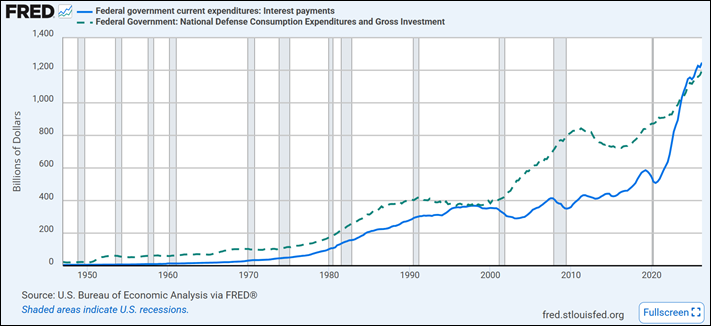
Treasury Secretary Bessent says "there's nothing magic about the $40 trillion number" and that we can grow our way out of it. I want that to be true, and in theory it can work: if the economy grows faster than the interest rate on the debt, the debt shrinks relative to the economy on its own. Right now the economy is growing about 6.6% a year in dollar terms against that 3.5% average rate, which sounds like a comfortable margin. But the government is still spending more than it collects even before it pays interest, which eats most of that margin. And of that 6.6% growth, only about 2% was real; the rest was rising prices. Inflation is doing most of the work, which is exactly the point of this letter.
An Ice Pack for a Fever
So what has the Treasury Department done about rising long-term rates? On August 19, two days after the 30-year hit its high, the Treasury announced it would more than double the size of its purchases of its own long-dated bonds. The next day Secretary Bessent went on CNBC and said "we are going to make a market in these" and that "yields don't reflect the underlying fundamentals." Three weeks later, on a stage in Dallas, he said: "I am the house now. You can bet against me if you want."
Howard Marks (who provided a lot of the intellectual scaffolding for this letter) disagrees: in his view long-term yields are reflecting the fundamentals exactly. He calls the buybacks a cosmetic fix and compares them to a doctor applying an ice pack to a patient with a fever. The temperature may come down for a while, but the patient does not get healthy until the underlying cause is treated. The market seems to agree with him. The 30-year yield was higher three weeks into the program than the day before it was announced. Druckenmiller again: "Every basis point of artificial yield suppression is a subsidy to procrastination. Governments defending prices against fundamentals always lose. The only variable is how much they spend before conceding."
This is where my frustration as a debt and deficit hawk boils over. We just watched the most public attempt at cutting federal spending in a generation come and go, and I think we can all agree that DOGE looks to have been a failure: the deficit kept moving in the wrong direction. Where we will not all agree is why. Some of you will say it was because the whole effort was idiotic and corrupt from the top down. Others will say the Congress that controls spending is too entrenched for any outsider to touch the spending on their districts, their friends, and themselves. I know opinions in this client base run in every direction, and I am not going to referee that one. What matters for this letter is the outcome, and the outcome is that the spending that actually drives the deficit (Social Security, Medicare, defense, and now interest) was never seriously on the table. Neither party will run on entitlement reform, and both know it. I have quoted Charlie Munger on this before: “The problem in a democracy, the populace eventually realizes it can vote itself all the money.”
Marks lays out what an actual fix looks like, and nobody in either party is proposing it: accept that we will never have less debt than we do now, start caring about budgets at all, hold spending growth below the growth of the economy, raise revenue as a share of GDP, and grow productivity, where AI is the one real hope. Cutting spending or raising taxes is painful. I do quite a few of my readers' tax returns, and none of you seem eager to pay more.
Not Just an American Problem
Before anyone concludes the answer is to flee the dollar for some other currency, look around. Britain now pays more to borrow for thirty years than at any time since 1998, France pays more to borrow than Italy or Greece, and Japan's 10-year yield is above 3% for the first time since 1996 (Sources: Bloomberg, via James Lavish). Marks asks the right question: if you move out of dollars and into another currency subject to the same debasement, what have you accomplished? In my view, nothing.
The United States is not uniquely broken; it is the biggest borrower in a room full of borrowers, and it still holds the world's reserve currency. That is a real advantage for keeping currency strong (but possible disadvantage of outsourcing your manufacturing base elsewhere; we can talk about that another time).
We Have Seen This Playbook Before
I'll repeat a point I've made a few times before because I think this is where things are going. The last time the United States owed more than a year's national output was the end of the Second World War. From 1942 through 1951 the Fed held the long Treasury bond at 2.5% and bought whatever bond issuances it took to keep it there. Then inflation arrived: 8.5% in 1946, 14.5% in 1947, and 7.75% in 1948, all against a bond paying 2.5% (Source: Federal Reserve Bank of New York). Anyone who lent the government money in 1945 was paid back in full, in dollars, and lost a great deal of purchasing power doing it. Debt fell from 106% of GDP in 1946 to 23% in 1974, and economists who have studied that decline find that roughly 40% of it came from holding interest rates below inflation. Economists call that "financial repression": paying savers less than a free market would. I think you are going to hear that term more and more going forward. Treasury buybacks, hints of smaller long-bond auctions, loosened bank rules that make Treasuries easier to hold, and a new law that turns stablecoins (digital dollars) into required buyers of T-bills all point the same direction. In 1942 the government did this by naming the interest rate and holding it there. In 2026 it is doing it by changing the conditions around the bond.
There is one reason the playbook will not work as well this time, and I owe the point to Luke Gromen of Forest for the Trees. In 1946, nearly everything Washington owed was a coupon on a Treasury bond: a promise of dollars, and dollars can be printed. Today the larger promises are not dollar promises. Medicare and Medicaid are IOUs for hips, knees, hospital beds, and a surgeon's hour, and Social Security checks step up automatically with inflation. You can print dollars. You cannot print a hip replacement. Capping the 30-year yield still lightens the Treasury's interest bill, but it does nothing to shrink the medical promise; if anything, every extra dollar printed bids up the price of the same scarce doctors and drugs. Inflation can shrink the bonds. It cannot shrink the hips.
Nobody can know for certain this is how it plays out. Marks himself points out that he and many others worried the money printing of 2008 would debase the dollar, and it did not; the reckoning may be much further off than the worriers think. But if you asked me which path is politically easiest, higher taxes, real spending cuts, or inflation that nobody has to vote for, I know where I would put my chips. Inflation is the shadow tax you can always try to blame on the other guy. It has always been the path of least resistance for a government that borrows in its own currency.
A Quick Word of Caution on the AI Trade
I wrote a longer piece on this in September, The AI Buildout and Who Actually Gets Paid, and the short version is that the people who finance a world-changing technology are often not the people who profit from it. A fifth of American railroad mileage ended in receivership in the 1800s. WorldCom and Global Crossing went bankrupt laying the fiber that Google and Netflix later made fortunes on.
Since writing that, the recent best analogy I have heard for the bear case is airlines. Commercial aviation was an amazing invention that changed the world. Everyone uses it. It is a trillion-dollar industry. And it has been a lousy investment for most of its history, because it is brutally competitive and requires enormous amounts of capital that have to be replaced every few years; the customers got the value and the shareholders got the bill. Many AI companies may turn out to be airlines: world-changing, universally used, and fighting each other so hard on price with such heavy capital needs that the returns never reach the people who paid for the planes. If trillions are being borrowed at 7% and up to build infrastructure that earns airline-like returns, that is a problem for the lenders and the shareholders both.
None of this means avoid AI. It means the durable returns are more likely to show up in the application layer and in the ordinary businesses that get cheaper intelligence, not necessarily in the companies pouring the concrete. Being right about the technology and wrong about who captures the profit is an expensive mistake. One I am trying to be very careful about.
What This Means for Your Portfolio
The common questions is "Should I sell my stocks?" The answer is clearly no. The problem described above is not a problem with American companies. It is a problem with American fiscal management and ultimately with the American dollar. If you sell your stocks, where does the money go? A bank account, a money market fund, a bond? Those are all the same dollars. You have not escaped the risk; you have concentrated in it.
Regarding bonds, our approach has not changed, and this quarter is the best argument for it I could have asked for. We keep maturities short to intermediate. Today the 2-year note pays about 4.7% and the 30-year about 5.3%: roughly half a percent a year of extra yield to take on twenty-eight additional years of inflation risk from a borrower who has just told you, out loud, that it intends to manage the price of its own bonds. That is not adequate compensation. For those of you in or near retirement, the dedicated sleeve of short-term bonds and cash covering several years of distributions is earning more today than it has in years, and that is the one silver lining of higher rates I will take without looking for the cloud.
Regarding stocks, great businesses with pricing power are the original inflation hedge; a company that can raise prices as its costs rise passes the debasement through to its customers, and its earnings and dividends grow right alongside the money supply. That is why we own them and will keep owning them. Two familiar cautions. First, a 5% risk-free Treasury yield is real competition for stocks, especially expensive ones, and U.S. large caps are still expensive. Second, a weaker dollar over time is a tailwind for the international holdings, which earned their keep in 2025 and the first half of 2026.
I’ll say again, I used Howard Marks for a lot of inspiration for this letter. I want to be upfront that I am a bit more bearish on the dollar than Marks is. His practical advice is not to overreact by moving out of dollar assets at scale; he thinks America's advantages remain largely intact, and that leaving American stocks in size could look like a mistake for a very long time. I take his caution seriously; I just think the fiscal picture warrants owning more outside the dollar than he does. Our answer is to diversify, not to flee.
Closing Thoughts
My job is not to forecast every twist and turn in the bond market; it is to build portfolios that can endure them and to keep you from reacting to headlines in ways that damage a plan built for decades. The government will pay you back. My job is to make sure you do not have to overly worry what those dollars buy. That is why we own great businesses around the world, why we keep our bond maturity short, and why we hold some currency hedging investments in our core portfolios.
Over the coming weeks we will be reviewing year-end tax planning, rebalancing, and, for many of you, Roth conversion opportunities; if the fix ever does come through higher tax rates, as Marks suggests it must, paying tax at today's rates on dollars you expect to grow looks a little better every year.
Thank you for reading. Please review our disclosures.
.png)

Subscribe to our Newsletter and Receive Important News & Updates.

Foundation Wealth & Tax Advisors is a Fee-Only, Fiduciary, Independent Financial Advisory Firm.
Check the background of your financial professional on FINRA's BrokerCheck.
The content is developed from sources believed to be providing accurate information. The information in this material is not intended as tax or legal advice. Please consult legal or tax professionals for specific information regarding your individual situation. The opinions expressed and material provided are for general information, and should not be considered a solicitation for the purchase or sale of any security.
We take protecting your data and privacy very seriously. As of January 1, 2020 the California Consumer Privacy Act (CCPA) suggests the following link as an extra measure to safeguard your data: Do not sell my personal information.