

The Tax Loophole That Doubles (Some) Couples' Tax Savings
During some routine tax planning for a client this summer, I stumbled on a curious loophole. That one would save this specific couple thousands in tax savings, every year.
It has to do with Health Savings Accounts (or HSAs). These are tax-advantaged accounts for medical expenses that you can also invest, so it can double as a retirement account, though not everyone’s healthcare provides access to an HSA.
If you do not meet the qualifications for an HSA – you can stop reading now. Unless you have the same passion for obscure tax strategies as I do.
Now that it’s just us with HSAs, or eccentric savers (my people), what makes an HSA different from other retirement accounts, such as IRAs or 401(k)s? It’s the only account that is triple tax-advantaged, meaning:
- Contributions go in pre-tax & reduce your income tax bill
- The balance grows tax-free
- Withdrawals for qualified medical expenses come out tax-free
Part Roth and part Traditional account, HSAs are powerful hybrids for tax-efficiency, if used correctly. So much so that certain industry leaders have suggested, after ensuring you're contributing enough to capture your company's full 401(k) match, the HSA is the next best account to fund (assuming you qualify).
Everyone has medical expenses eventually, and family coverage nearly doubles what you can put in. In 2026, the contribution limit is $4,400 for individuals and $8,750 for families.
Which is why I was stunned to hear about the HSA loophole for domestic partners that doubles the contribution limit to $17,500.
What about married couples?
If you're married and either spouse has family coverage, the IRS treats you as one unit. You share a single $8,750 annual “family limit” for contributions. Even if you split it between spousal accounts, the IRS considers two spouses to be one tax ceiling.
So, what changes when you're not married?
That sharing rule is written specifically for spouses, and domestic partners technically are not spouses in the tax code, so that same contribution limit doesn't apply.
If each partner is covered under a family-level high-deductible plan (HDHP), then each one gets their own full family account with their own family limit. Doubling the maximum contribution limit to $17,500. Even if they’re covered under the same family healthcare plan, domestic partners can still each contribute $8,750 to their own personal family HSA.
For this particular, unmarried couple, one partner was on her employer's HDHP with him listed as a domestic partner. That counts as family coverage for both of them. He opened his own separate HSA with Fidelity, and now they can both fund to the absolute limit.
In the 32% federal bracket, the extra $8,750 deduction is worth about $2,800 a year in federal tax alone, before state tax and before decades of tax-free growth.
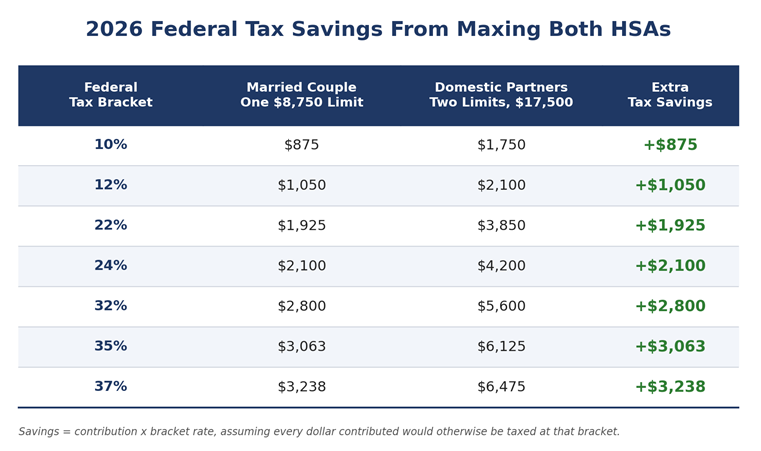
And that’s federal tax savings only. All states, besides California, reduce state income tax with contributions as well. Supposing you lived in my hometown Annapolis, Maryland, there would be an extra $1,350-$1,500 in yearly tax savings on top of the federal number.
The qualification checklist
These requirements must all be true to qualify for this loophole:
- You are not legally married. That includes common-law marriage in states that recognize it. If the IRS sees you as spouses, the shared limit applies.
- Neither of you is claimed as a tax dependent by the other, or by anyone else.
- Each of you is covered under a qualifying family-level HDHP. Being on your partner's employer plan as a domestic partner counts, though not every employer plan offers partner coverage.
- Neither of you has disqualifying coverage, meaning Medicare, a separate non-HDHP plan, or a general-purpose health FSA (a limited-purpose dental and vision FSA is fine).
- Each HSA is opened and held in that person's own name.
- You were eligible for each month you're contributing for. Join the plan mid-year and the limit is prorated, unless you stay covered through the following December and use the last-month rule.
If that last bullet point is confusing, that’s one of the reasons we recommend seeking out a financial professional before conducting this strategy yourself. With character and attention span limits, I’m only able to pass on so much here. And every person’s situation is unique, an advisor can help figure out what is right for you.
If this sounds like you
Contributions for 2026 can go in until April 15, 2027, so there's still time to open a second account and fund it for this year. If anything on the checklist is uncertain, confirm it before the money goes in. Excess contributions are unpleasant (to say the least) to unwind.
Be sure to talk to a financial professional to confirm you qualify for an HSA, and then for this loophole, before investing.
Thank you for reading. Please review our disclosures.
.png)

Subscribe to our Newsletter and Receive Important News & Updates.

Foundation Wealth & Tax Advisors is a Fee-Only, Fiduciary, Independent Financial Advisory Firm.
Check the background of your financial professional on FINRA's BrokerCheck.
The content is developed from sources believed to be providing accurate information. The information in this material is not intended as tax or legal advice. Please consult legal or tax professionals for specific information regarding your individual situation. The opinions expressed and material provided are for general information, and should not be considered a solicitation for the purchase or sale of any security.
We take protecting your data and privacy very seriously. As of January 1, 2020 the California Consumer Privacy Act (CCPA) suggests the following link as an extra measure to safeguard your data: Do not sell my personal information.